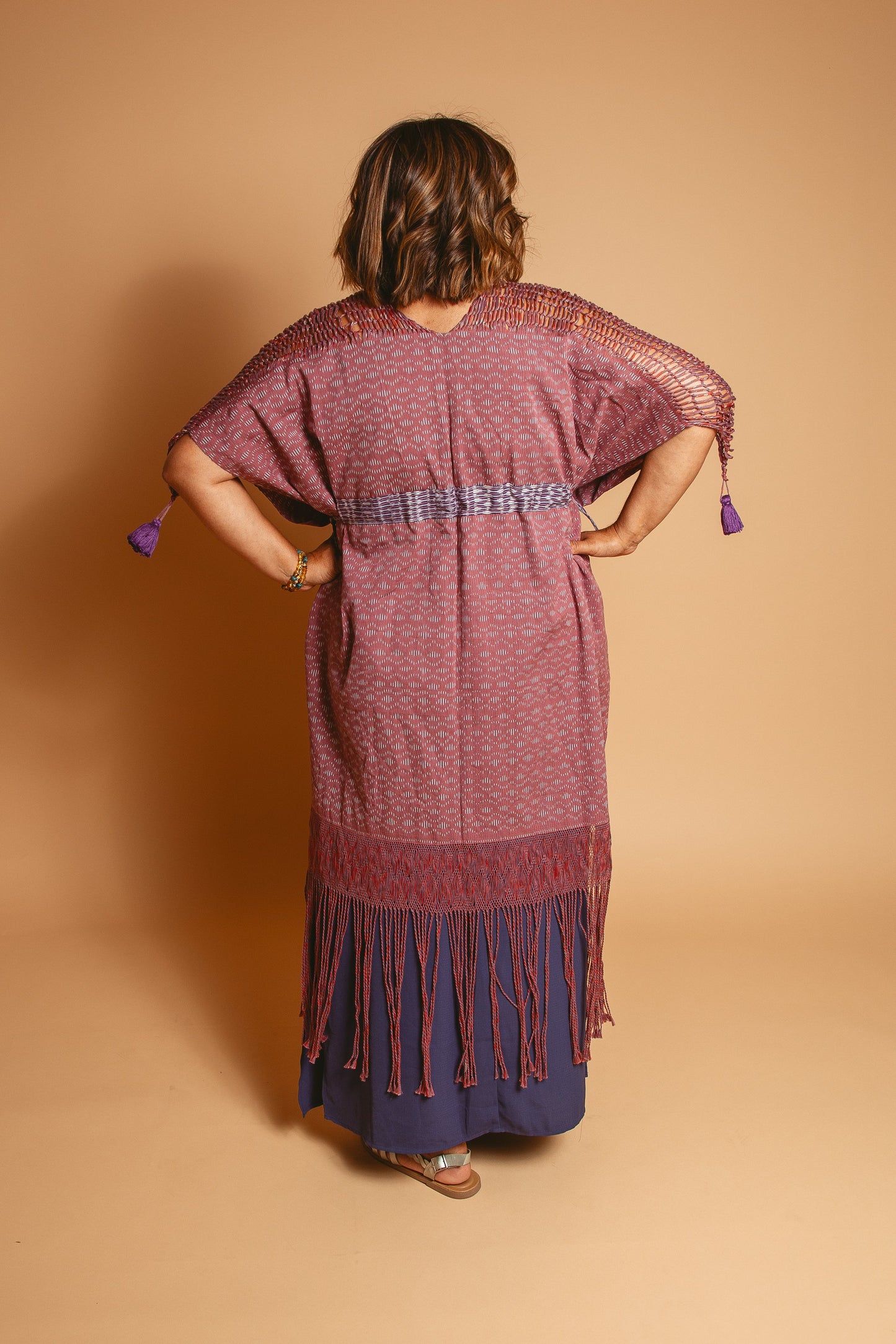
huipil dress Huipil de Playa – Cadena Collective
SKU: 27064722158
huipil dress

huipil dress Huipil de Playa – Cadena Collective

Sale price$18.84 Regular price$20.93
Save 10%
Size: 4

Pay in installments of $5.23 with ShopPay, AfterPay and Klarna

Shipping Estimate
USA
  • USA
  • CAN

Ships within 48 hours · Estimated delivery Jun 30 - Jul 5

Promo Codes Available:

For Your Every Summer RSVP, with Code: SUMMER15

Description

huipil dress Huipil de Playa – Cadena CollectiveBased in: Mxico When Camelia Ramos father passed away, he imparted to her a legacy: "Im proud to leave you knowing Ive taught you my craft, but now you have a commitment to not let this artistry die." Camelia embraced this solemn pledge with unwavering determination. Together with her husband, she tends to the flame of tradition in their artisanal workshop, El Xoxopastli, where the soulful art of rebozo making finds its sanctuary. Here, amidst the hum

Based in: México

When Camelia Ramos’ father passed away, he imparted to her a legacy: "I’m proud to leave you knowing I’ve taught you my craft, but now you have a commitment to not let this artistry die." Camelia embraced this solemn pledge with unwavering determination. Together with her husband, she tends to the flame of tradition in their artisanal workshop, El Xoxopastli, where the soulful art of rebozo making finds its sanctuary. Here, amidst the hum of meticulous craftsmanship, rebozos are not mere products of assembly lines or cold machinery. Instead, they are borne from a labor of love, each thread a testament to the enduring spirit of cultural preservation. 

In addition to mastering the traditional rebozo, she has innovated designs that encapsulate its essence. Each creation stands as a testament to her deep devotion to the craft. These pieces invite personal interpretation and style! Yet, amidst this freedom, lies a crucial understanding: the profound significance of the narrative and heritage woven into every thread.

I’m giving you my life made in a rebozo,” she proudly says. "My life hangs by a thread, and each thread carries my essence. Just like blood runs through my veins, so does thread. Because this is the wonder of being able to give you part of my being and my soul, captured in a rebozo."

Details
  • Made in: Malinalco, México
  • Dimensions: 31" width x 51" length (laying flat)
  • Color: Brown
  • Elaboration time: 3 months
  • Size: Will fit sizes S-2XL 
    • Nury is 5'1" and is a size S/M
    • Lucina is 5'5" and is a size XL
  • Materials: 100% Cotton
  • Specification: Innovation design by Camelia Ramos. Cover-up with 100% cotton thread, on a backstrap loom with a hand-knotted finish. Huipil is of great comfort to use in many ways, with straps to adjust to your figure on the sides or worn loose.
  • Care Instructions: While not in use, your design should be carefully hung on a non-slip velvet hanger. We recommend steaming to remove any wrinkles and brushing out the ends. Because of the delicate nature of the rebozos, we recommend that you dry clean. Do not bleach. Brush the ends before each use and avoid intense sun exposure.
  • Please note that sometimes you may find small imperfections due to its handmade process. This is a unique and true piece of art.
About the Technique

Ikat, a time-honored artisanal technique exemplified by the masterful craftsmanship of Camelia Ramos, represents a marriage of artistry and tradition. Rooted in the ancient practice of resist dyeing, Ikat stands as a testament to the meticulous skill and creative ingenuity of its practitioners. Unlike typical methods where patterns are either applied superficially or woven directly into the fabric's structure, Ikat weaves its magic through a series of deliberate and intricate steps. Central to the technique is the deliberate manipulation of yarns, both for the warp (longitudinal threads) and the weft (transverse threads). Before dyeing, sections of these yarns are meticulously protected with a resist material, oftentimes wax or tying, to preserve their original color. This painstaking preparatory phase lays the foundation for the distinctive allure of Ikat.

The dyeing process itself is a delicate dance of hues and gradients. Immersed in vats of natural or synthetic dyes, the unprotected portions of the yarn eagerly absorb the vibrant pigments, while the shielded segments retain their pristine hue. Through successive dye baths and meticulous adjustments, the desired pattern emerges, a testament to the artisan's vision and expertise. Once dyed, the yarns are carefully arranged on a loom, ready to be transformed into a textile masterpiece. With each pass of the shuttle, the pattern gradually takes shape, as the dyed yarns interlace with the uncolored threads. The resulting fabric is a symphony of color and design, where every thread tells a story of craftsmanship and tradition.

What sets Ikat apart is not just its visually stunning aesthetics but also its inherent sense of unpredictability and individuality. The slight imperfections and irregularities that characterize Ikat textiles serve as a reminder of its handmade origins, infusing each piece with a sense of warmth and authenticity.

In the hands of Camelia Ramos, Ikat transcends mere fabric; it becomes a canvas for artistic expression and cultural heritage. Through her skilled hands, timeless patterns come to life, weaving together generations of tradition with contemporary flair. Each piece bearing her signature reflects not just the mastery of a technique but the soulful dedication of an artisan committed to preserving the legacy of Ikat for generations to come.

About Camelia Ramos

Camelia Ramos Zamora was born on September 17, 1969, originally from Tenancingo, but as she claims, she was reborn in Malinalco, State of Mexico. She is now the fifth generation of backstrap loom weavers. From a young age, she was attracted to shawls, not knowing that her father had been a shawl craftsman since he was 13 years old but had abandoned it due to his economic situation to become a bricklayer. Enthusiastic about this art, she asked her father, the master craftsman Isaac Ramos, to teach her the artistry of rebozo making.

At first, Don Isaac was hesitant to teach her because traditionally the art of rebozo making was a man’s job and the woman would focus on refining the rebozo ends by twisting, braiding, and tying the ends. It wasn’t until Camelia’s husband, José Mancio, had a conversation with her father about also learning the art of rebozo making that her father showed up the next day to pass on his knowledge of rebozo backstrap loom weaving under the training of more than two years.

Since 1992, Camelia Ramos has overcome gender stigmas by inheriting the knowledge and work that was considered typical of men in her state. Her work meant the rescue of the making of the shawl on a backstrap loom, the use of the ikat technique with natural dyes, as well as the ancient rapacejo, following what she learned from her father. Then he decided to go one step forward: she innovated in the design of garments and accessories made with rebozos to transform into blouses or the traditional quexquemitl.

Today, Camelia and her husband José lead El Xoxopastli, an artisanal workshop that makes textile canvas on pedal and backstrap looms to keep the traditional rebozo techniques alive.

Shipping Notes
  • Free Standard Shipping on $100+ Orders to the USA.
  • Except Preorder products are shipped in 48 hours.
  • Delivery to the USA:
  1. Standard Shipping : 3-10 business days
  • If time is of the essence, please consider selecting expedited delivery for faster service.
Exchange/Return Notes
  • We offer a 30-day return/exchange service after receiving.
  • Final sale items are not eligible for returns or exchanges.
  • To process your return/exchange, please contact us at [email protected]
  • Please click here for more details>>> Return & Exchange Policy
SKU: 27064722158

Discover Niche Categories That Outsell huipil dress

Top-Converting Item to Boost Your Average Order

4.4 ★★★★★
Based on 2031 reviews
Sort
Highest Rating
Newest First
Oldest First
Product Reviews
P
Peggy Hardman
Waukegan, US
★★★★★ 4
Need my own copy.
Format: Kindle
Looking forward to more of her work, and rereading this book. Some very evocative lines awake my granma memories much like the granmother memories herein.
WAS THIS REVIEW HELPFUL?YesReportShare
Reviewed in the United States on February 24, 2022
R
Verified Purchase
Readergurl
West Palm Beach, US
★★★★★ 5
Amazing Book...
Format: Paperback
It takes a lot nowadays for me to rate any Fiction book 5 stars. I read way more non-fiction, and usually only read highly recommended fiction, or some that's given to me. There are plenty of other reviews here that tell you how it's not a "happy" book (why that matters i dont know), so i wont go on about that part. I dont base my reading choices on whether they have a happy fantasy story. This story is very real. The writing is really good. I have several points that i use to rate a book: the story itself, the actual writing style, the 'entertainment' value, the emotions it brings out - laughter, sadness, etc., and if it's very memorable - either by being very different than anything i've ever read, or by something else about it being very different. The only point out of all of those that i wouldnt give a 5 would be the writing style/prose - which i'd give a 4. It's very good, but not "amazing" to me like some authors are. The author brought me into the characters - where i could feel what they were feeling, and i understood why they did the 'bad' things they did - totally. I felt the way they lived, the area, the poverty... As the story progressed, i stayed up one night for HOURS wanting to know what happened - until the sun rose actually. As the finale was coming - which i had no idea would be the way it was - i was literally gripping the book with both hands and holding it up to my face. I realized this and laughed to myself since i hadnt even noticed. Then - i sobbed thru the last 20 pgs - i havent cried from ANY fiction for a long time. Yes, i get into books and really let them take me away, but this book has a special kind of writing and a special story that i never expected to effect me sooo much. The author THEN does something so amazing at the very end - when i couldnt believe it could get any better. I KNEW what i wanted to happen - and i kept thinking to myself, "no, it wont - because it will just seem to corny if it does." (Even tho i wanted it so much.) She made it happen in a special way, without making it corny but while bringing me the hope and good feeling i needed after all the sobbing. (I dont want to give anything away just in case you dont know the story.) This book scores an A+. If you love good, moving, American fiction you will love this.
WAS THIS REVIEW HELPFUL?YesReportShare
Reviewed in the United States on October 21, 2013
F
Verified Purchase
Francophile in Michigan
Waukegan, US
★★★★★ 4
Brava, Ms. Ward
Format: Paperback
I read this novel, along with nine others, for a college literature course. Of the ten, this was the only book to elicit a strong emotional reaction from me. There were moments when I hung my head in frustration, threw up my hands in respect (God bless Ward’s writing style), and wiped my face of tears and snot after crying my eyes out. An incredibly moving and poignant novel. The novel opens with its narrator Esch, fourteen years old and pregnant. She often follows her brothers around, and is constantly surrounded by men as well as the gruesome society of dog-fighting. Esch’s predominant male surrounding is, perhaps, the main influence that encourages her to sleep with her brother’s friends, and to submissively pine for the one boy, Manny, who unforgivingly mistreats her. Though Esch’s character was impeccably frustrating, and borderline stereotypical and archetypal, her faults lie with a motherless young girl, who wants to be wanted and loved. Both frustrating and annoying, this characterization was, at times, unlikable, yet that is exactly what made Esch so human. I applaud Ward’s lyrical writing style, as well her ability to write such gruesome and honest depictions that made me literally cringe when reading. Ward is able to effortlessly incorporate poetic language into her novel that, at times, made me set the book in both awe and envy, knowing I would never be able to produce such a product. I did find there to be a disconnect between the poetic language and the colloquial diction. That’s to say, I found it a bit unbelievable that Esch would speak so poorly to her family and friends, yet express herself so eloquently in her narration. Regardless, I found the poetic language to be successful and moving. I knew before reading the book that it was centered on Hurricane Katrina. However, I was surprised that the novel was centered on the build-up to the hurricane. Katrina itself is more or less twenty pages. The chapter pertaining to the hurricane, as well as the aftermath of the hurricane, were the sections of the novel that I found most captivating. Living through the hurricane with Esch and her family was difficult to read, which is perhaps why Ward chose to limit its description. That said, I wish I had more of Katrina and its aftermath. I waited for the hurricane for 200 pages, and it seemed to end as soon as it started. Though I was unsatisfied by the ending, I appreciated that the novel was a work that was not so much about Katrina as it was about survival and family. I was captivated by Ward’s poetic writing and honest characters. I will definitely be on the lookout for her other works, as well as an avid recommender of this novel.
WAS THIS REVIEW HELPFUL?YesReportShare
Reviewed in the United States on December 10, 2015
G
Verified Purchase
Gary Carden
San Leandro, US
★★★★★ 5
00 361 pages Hurricane Katrina spawned an awesome number of literary works
Format: Kindle
Salvage the Bones by Jesmyn Ward New York: Bloomsberry $24.00 361 pages Hurricane Katrina spawned an awesome number of literary works, and it may be that, given sufficient time to determine the full merits of Jesmyn Ward’s novel, Salvage the Bones, her work may be the most worthy. Perhaps the theory that great disasters (wars, natural disasters) invariably produce great works of art (operas, novels, paintings, etc.). This theory was often discussed by Flannery O’Conner who commented on the irony of the “creative renaissance” in southern literature which owes its origin to the extensive suffering and injustice associated with slavery and the Civil War. The narrator of Salvage the Bones is Esch, a fifteen-year-old girl living in Bois Sauvage, a predominately black bayou town which happens to be in the direct path of Katrina. Set in the twelve days leading up to, and just after the arrival of the hurricane, the novel presents each day as a distinct vignette. Esch and her brothers spend each day preparing for the terrifying arrival. They have no intention of leaving and attempt to help their drunken father reinforce their shack with sheets of plywood. They collect and store bottles of drinking water. Food supplies tend to consist of Top Ramen moon pies, vienna sausage, potted meat and eggs gathered in the woods. However, despite Katrina’s approach, Esch and her brothers seem to be primarily concerned about their white pit bull, China who has just given birth to five pups. China has developed a reputation in the dog fights that take place in “The Pit” in Bois Sauvage. She is a killing machine, a fact that makes Esch and her brothers the envy of their neighbors. The family’s meager economic security depends on China and each day is spent grooming, washes and feeding her. Indeed they fawn over the big dog, telling everyone that her puppies will grow up to have a killer instinct and therefore, they are invaluable. Much of the intrigue in Esch’s daily life revolves around protecting China and her pups. Skeetah is Esch’s oldest brother and the dog’s self-appointed trainer. Esch has a multitude of problems. She struggles to love her handicapped father and is haunted by the memory of her mother’s death. Now, she discovers that she is pregnant by Bois Sauvage’s “golden boy,” Manny, the boy who put the baby inside her is totally indifferent to the consequences of a rough and tumble frolic in the dark. As each day brings more distress, the homely, pug-faced teenager turns to her imagination, searching for a means to deal with the world around her, and as luck would have it, that is Edith Hamilton’s Mythology, which was a required reading at school. Esch begins to see the people around her as characters in her favorite book. She observes that all the girls in Bois Sauvage seem to be acting like their mythical counterparts: Psyche, Eurydice, Daphne - all of them running away from something or running after someone. However, the mythical character that Esch selects for her own role model is an ominous one. It is Medea, the fierce and vindictive wife of “the golden-haired Jason, who kills her own brother when he stands in the way of her love for Jason; and when that love turns to hate, she then murders Jason’s new wife, Creusa, her father, Creon and even kills her own children. Of course, Esch is not going to harm anyone. Although she is filled with rage at the world around her, she is actually one of the forces that is holding everything together; China, the white pitbull is another. When Katrina reaches landfall, it comes like some apocalyptic act of God, sweeping everything away, including Esch’s home and all of their feeble efforts to battle the rising water. In the end Salvage the Bones acquires a kind of epic grander. Like Noah or Gilgamesh, the waters finally withdraw, leaving a confused and humbled Bois Sauvage. How much has been lost? The puppies are gone and so is China - but given the dog’s character, she may have survived. Perhaps Skeetah and his brothers will find her. The reader is left with a singular image. Skeetah, the oldest brother sits in the wreckage of their home, and while everyone else is searching for missing children, furniture and cars, Skeetah looks at his brothers and announces, “She will come back to me.” Esch tells us: “He will watch the dark, the ruined houses, the muddy appliances, the tops of the trees that surround us whose leaves are dying for lack of roots. He will feed the fire, so it will blaze bright as a lighthouse. He will listen for the beat of her tail, the padding of her feet in the mud. He will look into the future and see her emerge into the circle of his fire, beaten dirty by the hurricane so she doesn’t gleam anymore. So, she is the color of his teeth, his eyes, of the bone bounded by his blood, dull but alive, alive, alive, and when he sees her, his face will break and run water. And what of Esch who loves the white dog? She says that China will look at me and know “I am a mother.” Hopefully, it is apparent that this is a remarkable book. However, it was almost lost in the loud braying and confusion that dominates much of publishing business now. Even so, it won the National Book Award in 2011. Now, after a strange silence, it is beginning to get the attention that it deserves.
WAS THIS REVIEW HELPFUL?YesReportShare
Reviewed in the United States on March 3, 2016
A
Verified Purchase
Amazon Customer
Birmingham, US
★★★★★ 5
however the family takes precautions leading up to the storm to plan for one of the worst natural disasters in American history
Format: Paperback
Salvage the Bones is a deeply personal account of a young woman, Esch, and her family's life in the few days before Hurricane Katrina. The novel is set on the family's land in a small town in Mississippi. She lives with her father, her mother seven years deceased, and her three brothers, Skeetah, Randall, and Junior. Esch has recently learned that she is pregnant with the child of one of her older brother's friends. Skeetah takes care of his pitbull, China, helping her give birth and grooming her to fight for the family's honor. Randall plays basketball in hopes of gaining a college scholarship. Junior is a product of the mother's death, as she passed away giving birth to him, and leaves the family to mother him for the rest of his life. The novel describes the family's relationships with one another before the hurricane will rock them and test their connections to one another. The novel is not set decisively around the hurricane, however the family takes precautions leading up to the storm to plan for one of the worst natural disasters in American history. Jesmyn Ward provides a semi-autobiographical context of the hurricane, as she was born in a small, rural community in Mississippi, similar to the one she describes in Salvage the Bones. Ward writes commonly in this tone, and her newest novel, Men Who Reaped, describes the lives of four men in her life that had suffered deaths far too young. The novel is poetic in its writing style, and a beautiful read. Ward describes herself as a "failed poet," however, by reading the novel, it is clear that she succeeds in her poetry. Metaphors follow each line of description, and Ward is able to connect figurative language with the colloquial language of characters living in a rural community. It is undeniably pleasurable to read through the pages. Ward creates lovable characters and leaves the reader longing to discover what happens after the hurricane, and how the favorite characters are surviving in the wake of the natural disaster. There is a large dog presence throughout the novel, in addition to family ties, the novel provides a sense of companionship and a person's human relationship with his dog. The dog becomes a member of the family, and the relationship is called into question with the severity of the storm and the need to hold onto the most important things in times of crisis. I am overwhelmed with the poetic nature of this book and applaud Ward as an exceptional writer.
WAS THIS REVIEW HELPFUL?YesReportShare
Reviewed in the United States on November 23, 2015

recommand products